

Self-Leveling Floor Screed: Coverage Calculator and Application Guide
Pours a perfectly flat floor.
Wondering how many bags of self-leveling compound you actually need? The calculator above already did the math. This guide explains the formula behind it and helps you avoid the two most common mistakes: buying too little (project stops mid-pour) or too much (wasted budget).
The baseline consumption for self-leveling screed is 1.6 kg per m² per mm of thickness. That number covers most cement-based products from Ceresit, Knauf, Baumit and similar brands. Gypsum-based products may differ slightly - always check the bag. For a typical 10 mm finish layer over 20 m², that's 320 kg plus a 10% safety margin, so roughly 352 kg total.
What the Calculator Measures
Self-leveling screed (also called floor leveling compound) is the layer you pour on top of a rough base - concrete slab, old screed, or subfloor - before laying tiles, laminate, or vinyl. It flows and settles flat on its own, filling low spots without manual screeding.
The calculator works with three inputs:
- Floor area in m²
- Layer thickness in mm (typically 3-10 mm for finish layers)
- Bag weight (usually 25 kg)
Result: exact number of bags, with 10% overage already built in.
When you need this product
- Under ceramic tiles or stone where you need a flat base
- Over underfloor heating pipes as a thin finish layer (check minimum thickness requirements with your heating system supplier)
- In apartments where the concrete slab has dips of 3-8 mm across the room
How to Calculate Coverage - The Formula Explained
The formula is simple to verify manually:
bags needed = (area m² × thickness mm × 1.6 kg) ÷ bag weight × 1.10
The 1.10 multiplier is your 10% safety buffer. Never skip it - joints, corners and slight variations in base flatness always consume more than the theoretical minimum.
Example: 20 m² room, 10 mm layer, 25 kg bags
- 20 × 10 × 1.6 = 320 kg
- Add 10%: 320 × 1.10 = 352 kg
- Divide by bag weight: 352 ÷ 25 = 14.1, round up to 15 bags
If your actual floor measurement shows dips deeper than your target thickness in some spots, add extra bags for those areas - the calculator assumes uniform thickness.
Primer matters too
Before pouring, prime the substrate. Unprimed concrete will absorb water from the mix too fast, weakening the surface layer. One coat is usually enough on smooth concrete; porous substrates may need two.
Tips for a Good Pour
Tools you actually need:
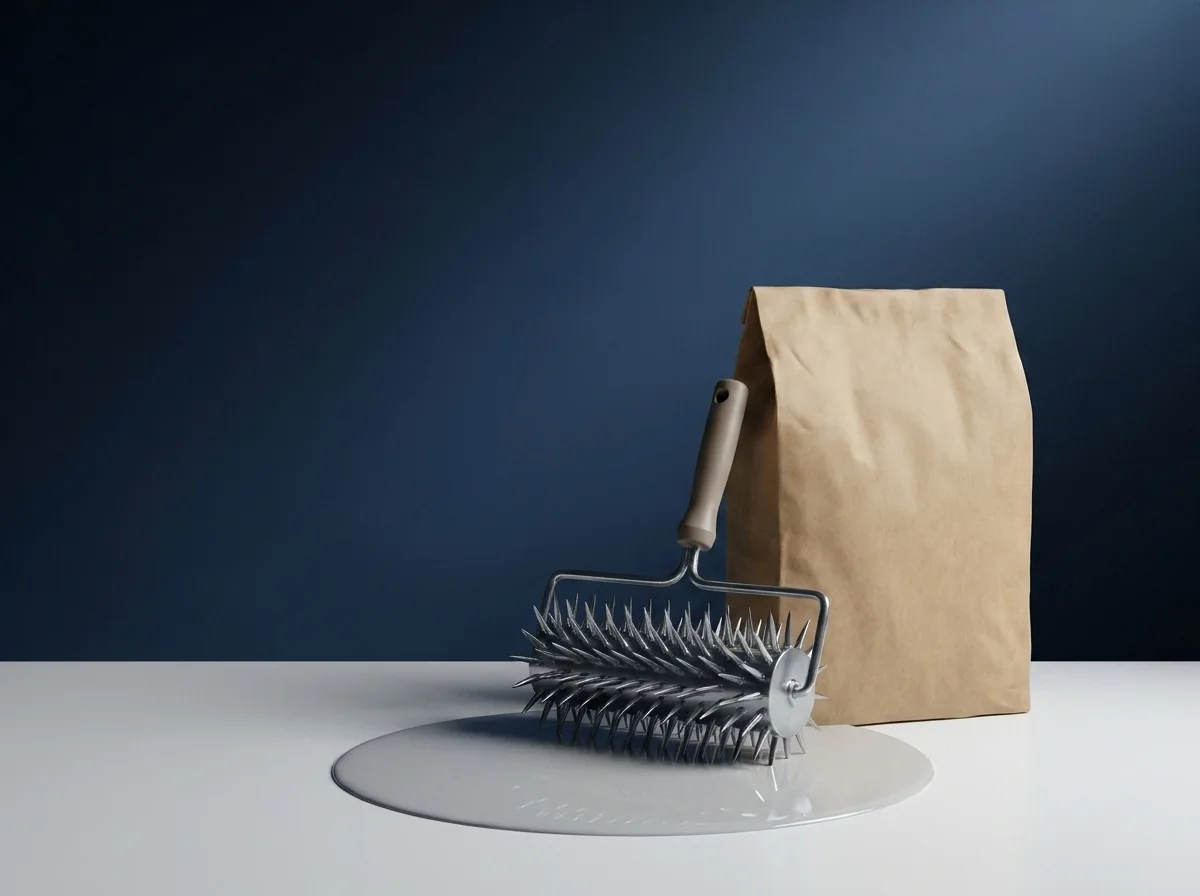
- Spike roller (degassing roller) - mandatory. Roll it across the surface immediately after pouring to release trapped air bubbles. Without it, you get surface pitting.
- Gauge rake or spreader - to push the mix to the right depth before it self-levels
- Bucket and mixer drill - mix to a smooth lump-free consistency per the bag instructions
Temperature: minimum +10°C in the room and on the substrate. Below that, the mix won't cure properly. In Moldovan winters, unheated sites are a real problem - plan accordingly.
Drying time: a 10 mm layer typically takes 24-48 hours before foot traffic, but wait the full cure time (check the bag - usually 7-28 days) before laying floor coverings.
Don't open windows for "faster drying." Drafts cause uneven evaporation and surface cracking. Keep the room closed and at stable temperature.
Colorista.md stocks Ceresit, Knauf, Baumit, Weber, Atlas and Supraten. All available in Chisinau with delivery across Moldova. Use the calculator, get your number, order online.
Frequently asked questions
How many bags of self-leveling compound do I need for 20 sqm?
At 10 mm thickness and standard consumption of 1.6 kg/m²/mm, you need 320 kg base + 10% margin = 352 kg. With 25 kg bags that's 15 bags. The calculator above gives you this number instantly for any area and thickness combination.
What is the minimum thickness for self-leveling floor screed?
Most products specify a minimum of 3 mm. Going thinner risks cracking and poor adhesion. For underfloor heating installations, check the heating system manufacturer's requirements - they typically specify total screed thickness above the pipes, not just the self-leveling layer.
How long does self-leveling screed take to dry before tiling?
Light foot traffic is usually possible after 24-48 hours for a 10 mm layer. However, tiling should wait for full cure - typically 7 to 28 days depending on the product and room conditions. Check the specific bag instructions. Rushing this step causes tile debonding.
Do I need primer before self-leveling compound?
Yes, always. Primer seals the substrate so it doesn't draw water from the mix too quickly. On concrete, one coat is standard. On very porous or dusty substrates, two coats work better. Let the primer dry fully before pouring - usually 1-2 hours.