

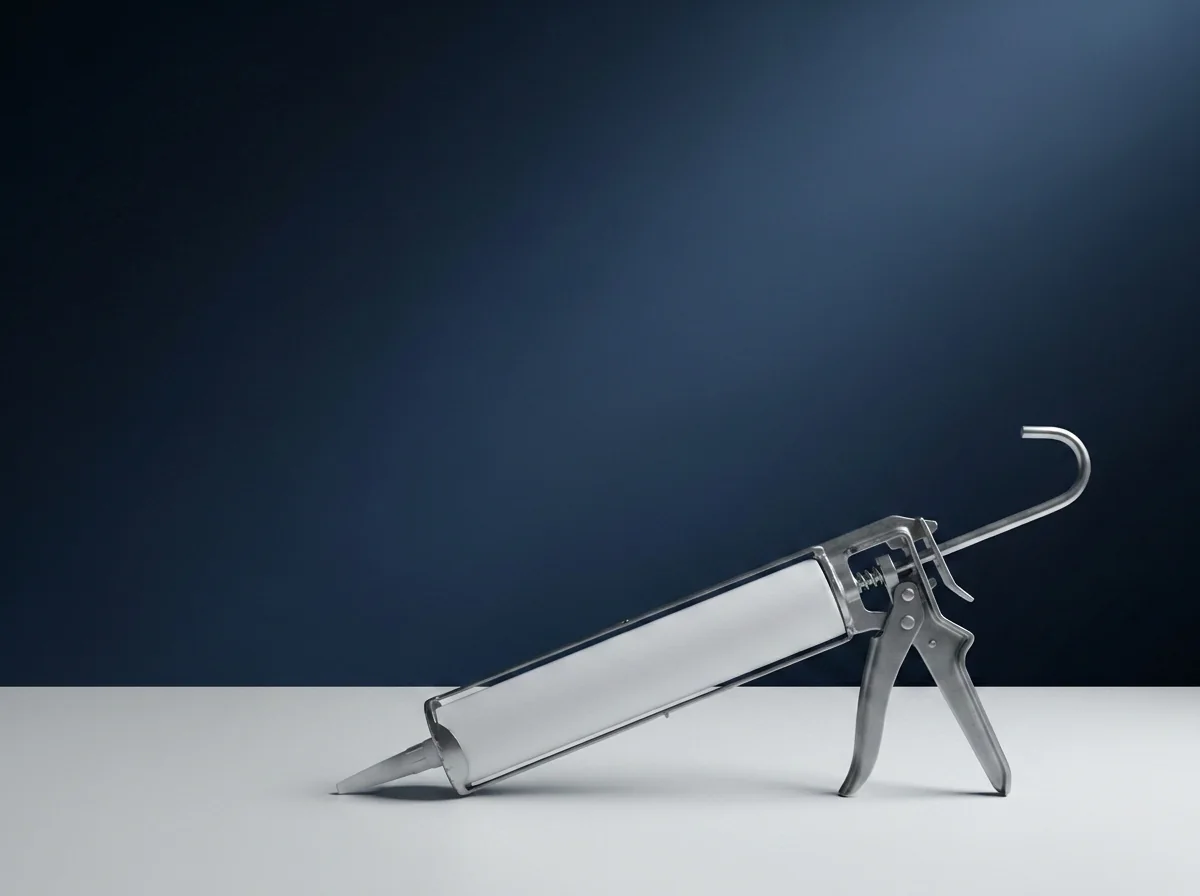
Sealant Consumption Calculator: How Many Cartridges for Your Joint?
Seals joints and gaps.
Ever stood in the hardware aisle holding two cartridges wondering if that's enough - or way too many? The sealant consumption calculator on this page does the math for you. Enter your joint width, depth and total length, and you get the exact cartridge count, already including a 10% waste buffer.
The formula is simple: cartridge yield equals cartridge volume in ml divided by joint cross-section in mm². A standard 6x6mm joint has a cross-section of 36 mm². One 290ml cartridge covers roughly 8 linear meters of that joint. Scale up from there.
What Does This Calculator Actually Count?
The calculator works for any elastic or rigid joint sealant - silicone (sanitary or neutral), acrylic, or polyurethane. It doesn't matter whether you're sealing a bathroom tile-to-bath gap, a window frame, or an exterior expansion joint.
What determines consumption is joint cross-section (width x depth in mm²), not the surface area. A 10mm-wide shallow joint uses less material than a 6mm joint cut 10mm deep. That's why the calculator asks for both dimensions separately.
Brands available at Colorista.md: Ceresit, Soudal, Den Braven, Supraten - all in stock in Chisinau for same-day or next-day delivery across Moldova.
How to Calculate Sealant Consumption Step by Step
Most people eyeball the quantity and end up either one cartridge short at 11pm, or with three leftover tubes they'll never use. Here's the method that actually works.
Example: bathroom joint at the tub-to-tile line, 6mm wide x 6mm deep, total length 5 meters.
- Cross-section: 6 x 6 = 36 mm²
- Cartridge volume: 290 ml
- Raw yield: 290,000 mm³ ÷ 36 mm² = ~8,050 mm = ~8.0 linear meters per cartridge
- Your length: 5 meters -> 5 ÷ 8 = 0.63 cartridges
- Add 10% waste: 0.63 x 1.10 = 0.69 -> round up to 1 cartridge
The calculator handles all of this automatically. Just input your numbers.
Sanitary, Neutral, Acrylic, or Polyurethane - Which Type?
This trips up a lot of buyers. Quick breakdown:
- Sanitary silicone - contains antifungal agents, designed for bathrooms, showers, kitchens. Resists mold. Don't paint over it.
- Neutral silicone - for glass, aluminum, UPVC window frames. No acetic acid, so it won't corrode metal surfaces.
- Acrylic sealant - paintable, interior use only. Good for skirting boards and interior architraves where you want to paint over the joint.
- Polyurethane sealant - exterior expansion joints, high-movement areas. Paintable and UV-resistant.
Not sure which one fits your job? Call us or drop a message - the team in Chisinau can advise.
Frequently asked questions
How many linear meters does a 290ml silicone cartridge cover for a 6x6mm joint?
At a 6x6mm joint (36 mm² cross-section), a 290ml cartridge covers approximately 8 linear meters before waste factor. With the recommended 10% buffer included, plan for around 7.2 usable meters per cartridge. The calculator adjusts automatically based on whatever volume you enter.
Why add a 10% waste factor to the sealant calculation?
Because real-world application always wastes some material - cleaning the nozzle, priming the gun, starting and stopping at corners, and the small amount that stays in the cartridge tip. 10% is the minimum. For complex shapes with many corners or an inexperienced applicator, use 15%.
Can I use acrylic sealant instead of sanitary silicone in a bathroom?
Not recommended. Acrylic absorbs moisture and loses adhesion in consistently wet areas. Sanitary silicone stays flexible and contains antifungal additives that prevent mold growth at the joint line. For the tub-to-tile joint specifically, always use sanitary silicone.