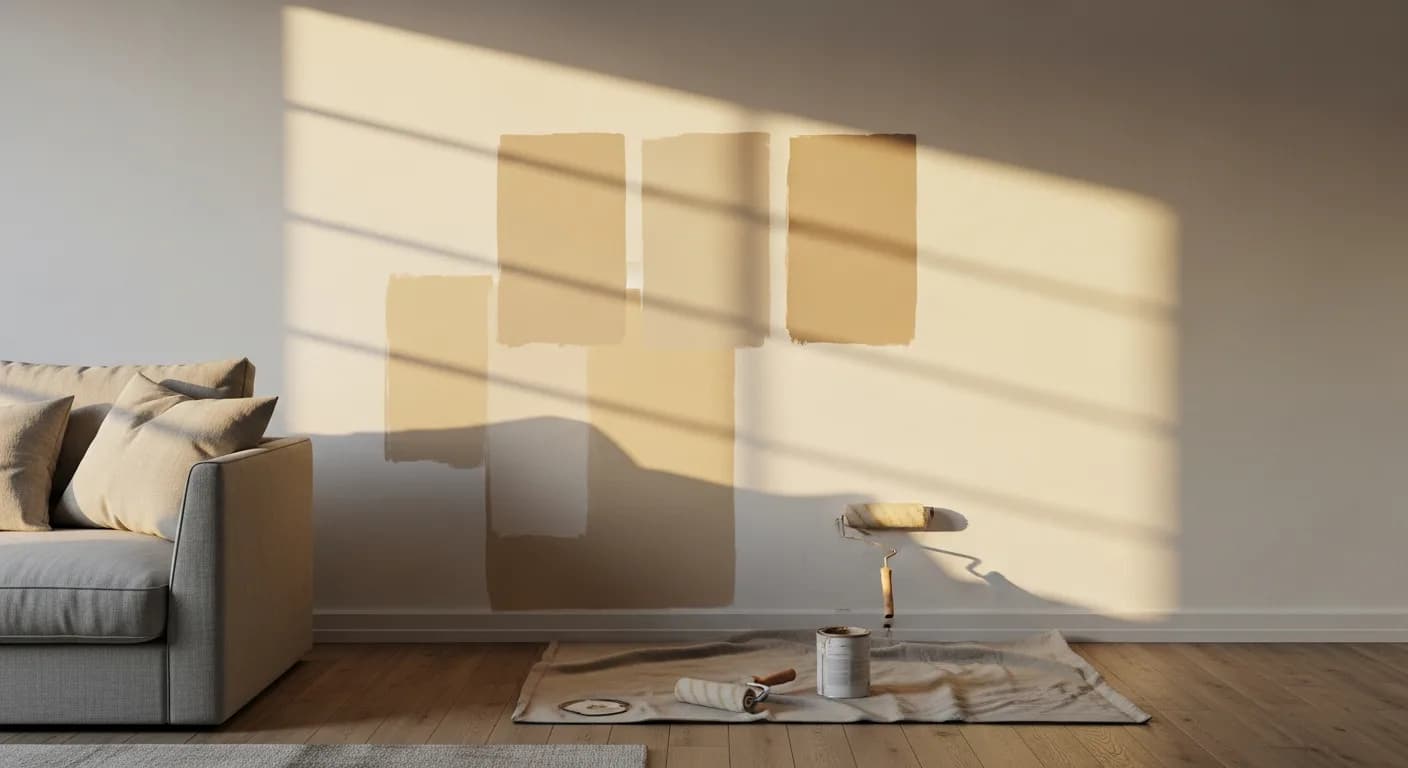
How much paint do you need for a room: count it once

Ever had that moment when the roller starts scraping a dry wall and the can is empty? Half a metre to the corner. Shop's closed. I went through that about twenty times before I learned to count first.
Let me show you the formula I use on jobs around Chișinău. You can do it in your head in two minutes. And at the end I'll tell you why you don't even have to do the math by hand - there's a paint calculator on the site that runs the numbers for you.
Measure your wall area: perimeter times height
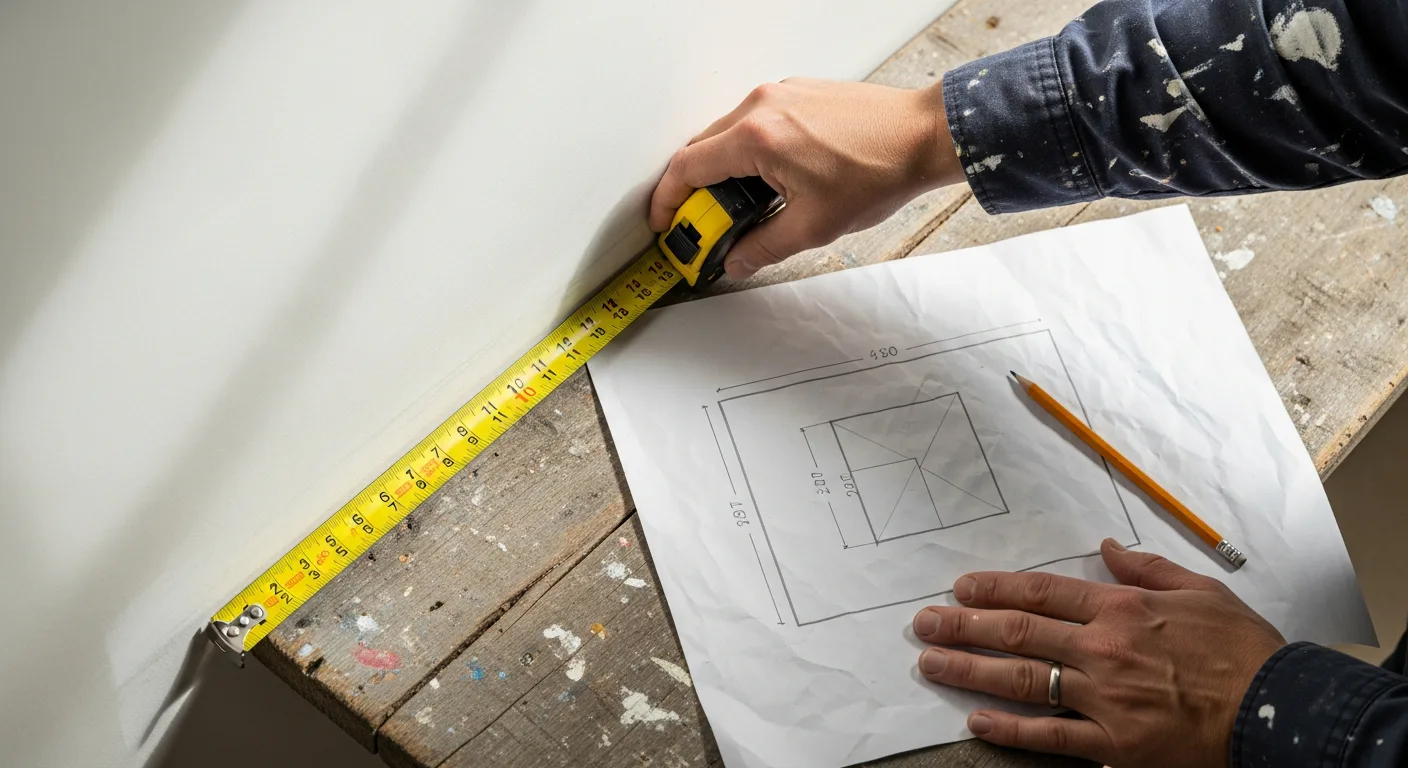
The formula's simple. Add up the length of every wall (that's the perimeter), multiply by the ceiling height. That gives you total wall area.
Take a room 4 by 3 metres, ceiling 2.7.
- Perimeter: (4 + 3) × 2 = 14 metres
- Wall area: 14 × 2.7 = 37.8 m²
Now subtract what you won't paint. A window is roughly 1.5 m². A door, about 1.6 m². Together a bit over 3 m². Take it off and you're left with around 35 m². That's your working area.
Count the ceiling separately: length times width, here 4 × 3 = 12 m². Painting that too? Add it in.
One small caveat from me. I don't always subtract windows and doors. With one or two, the difference is pennies, and you need the buffer anyway. Subtracting matters when you've got floor-to-ceiling glass or two doors. Then the minus is real.
Find your paint's coverage
Now the key number: how many square metres one litre covers. It's on the can, listed as coverage or spreading rate.
Water-based acrylic interior paints cover anywhere from 7 to 13 m² per litre. Usually 7 to 9. Why the spread? Two things.
First, the paint itself. A thick, dense, high-hide paint covers fewer metres but in one pass. A thin budget one stretches further and asks for more coats.
Second, the surface. A smooth filled wall drinks little. Rough plaster, old whitewash, bare drywall with no primer will eat a litre twice as fast. That's why primer isn't a frill: a deep-penetration primer firms up a crumbly base and cuts your paint use. It pays off.
We'll use 8 m²/l for the math, an honest middle. Divide area by coverage: 35 ÷ 8 ≈ 4.4 litres for one coat.
Two coats isn't two times one
Here's where most people slip. The logic feels solid: one coat is 4.4 litres, so two must be 8.8. Grab a nine-litre can, done.
In practice the second coat uses less. The first goes onto a dry base that pulls paint into itself. The second rides over paint already there, glides, levels out, spends less. From what I've seen, a second coat takes about 20 to 30% less than the first.
So for our room, two coats actually run closer to 7.5 litres, not 8.8. Counting a flat ×2 just means you overpay.
Dark and saturated colours flip this. Deep navy, wine, graphite, emerald, they almost always want a third coat. A light paint covers in two. A dark pigment doesn't, it shows through. That third coat adds roughly 40% to your total. Bake it in from the start if you've picked a dramatic shade. Getting that colour down evenly without streaks is its own skill, by the way, I wrote about roller technique here.
Add a 10 to 15% buffer, and here's why
Got 7.5 litres? Don't buy 7.5. Buy 8.5 to 9. That 10 to 15% buffer isn't nerves. It's three real reasons.
Touch-ups. You'll knock a wall with furniture here, chip a corner there, spot a missed patch only in daylight a week later. With no paint left, you're driving back for a can over two dabs.
The tricky spots. Corners, the zone behind the radiator, window reveals, they all soak up more than a flat field.
And the big one: the tint batch. This is the rake people step on most often.
Don't buy to the litre: shade drifts between batches
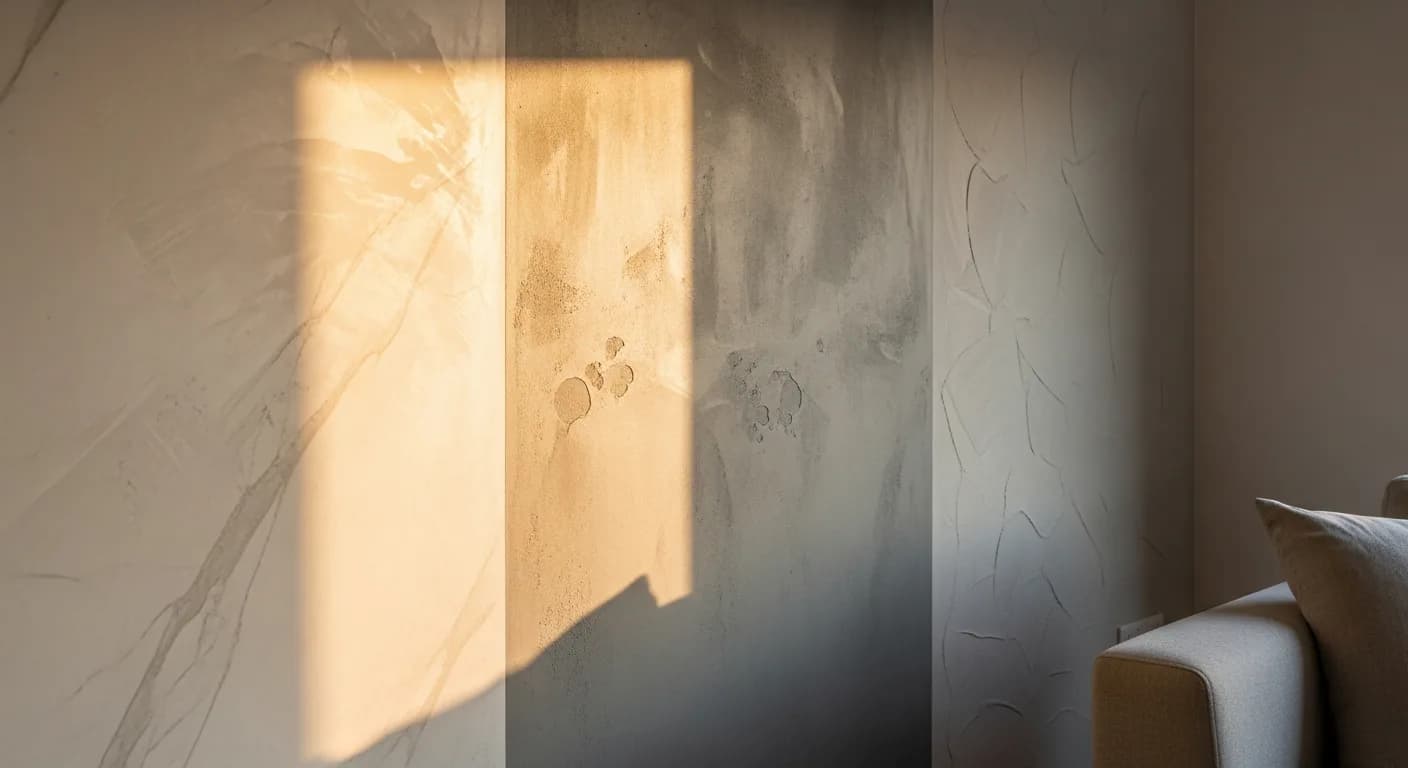
Tinted paint is mixed in batches. The machine doses pigment to a tight tolerance, but a tolerance exists. Two cans of the same colour code, mixed on different days, can come out a touch different. You won't catch it by eye in the can. On the wall, in side light, you will.
So what happens when you buy to the litre and come up half a can short? You drive over, buy more, they mix a fresh batch. You blend it onto the wall, and a couple of weeks later you spot a faint line where old paint meets new.
That's why the rule's firm: buy the whole job at once, one batch, with a buffer. Painting a big area that needs several cans? Pour them into one bucket and stir before you start. Painters call it boxing. It averages out any drift between cans so the wall comes out even.
Don't toss the leftovers. A sealed can with the colour code written on it sits happily for future touch-ups. Scuff the wall a year later and you patch it with the same paint, no shop run, no guessing the shade.
Skip the math: get the litres in 10 seconds
Everything I just walked through, the calculator on the site does on its own. You enter the room's length, width, height and the number of coats, and it returns the litres based on coverage and points you straight to a can of the right size. Not just paint either: it handles primer, filler and plaster too.
Doing it by hand is worth understanding so you know where the number comes from. But when you need a quick budget for a renovation, the calculator won't fumble a multiplication at 1 a.m. I use it myself to quote clients on the spot.
Looking for the paint to match your numbers? Browse the paint category. And if you haven't settled on a type and finish yet, read how to choose interior paint first. It saves money and headaches.
FAQ
How much paint do I need for a 20 m² room?
You count wall area, not floor area. For a 20 m² floor (roughly 4.5 × 4.5), the walls at a 2.7 ceiling come to about 48 to 49 m². Two coats in a mid-range paint run roughly 9 to 11 litres with a buffer. The calculator nails it exactly.
What's the paint coverage per litre over two coats?
Go by 7 to 13 m²/l per coat, usually 7 to 9. Two coats don't double it, they run about 60 to 80% more than one, since the second coat is leaner. That's around 0.2 to 0.3 litres per square metre for both coats.
Why buy extra instead of topping up later?
Tinted paint from a new batch can come out slightly off in shade. The seam between old and new shows in side light. A 10 to 15% buffer covers touch-ups from the same batch.
How many coats for a dark colour?
Usually three instead of two. Dark pigment shows through, and that third coat adds about 40% to your total. Plan for it from the start.
Stuck on the numbers or the paint type? Drop by the showroom on Uzinelor 6A or ask in the site chat and we'll work it out together.